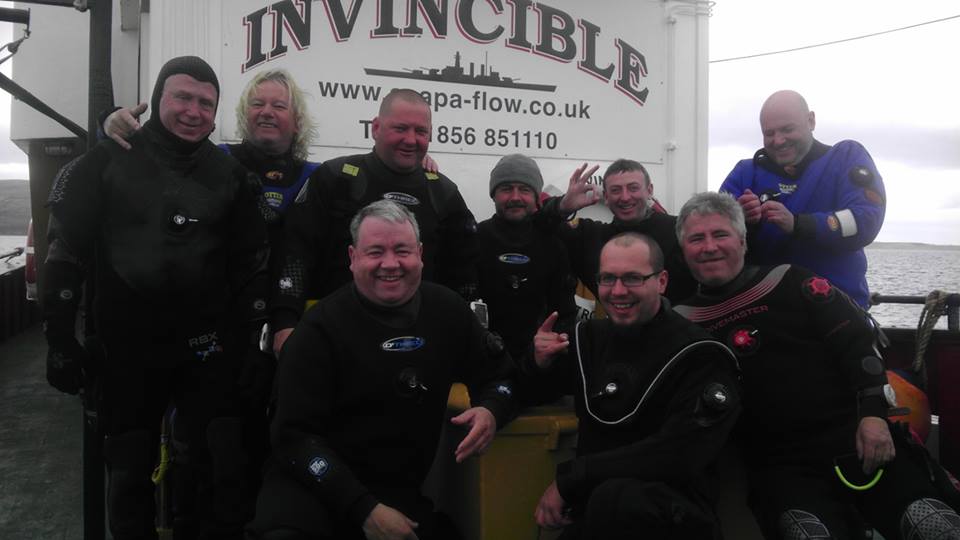
2015 Diving Season

2015 Diving Season

Blog

  1. Home
  2. /
  3. 2011
diver in the water

2015 Diving Season

9 Jun, 2026
Pat

Pat

Chairperson

Instagram
Instagram
Instagram
Instagram
Instagram

Related Posts

2015 Diving Season

2015 Diving Season

Blog Phasellus consequat orci eget ex euismod vulputate at quis lorem. In euismod accumsan tortor, quis dictum ligula lacinia sit amet. Aliquam eget vulputate urna. Integer posuere lobortis elit, ac dignissim elit ullamcorper vitae. Mauris dignissim...

read more
Umbrella Rides The Wind

Umbrella Rides The Wind

Blog Phasellus consequat orci eget ex euismod vulputate at quis lorem. In euismod accumsan tortor, quis dictum ligula lacinia sit amet. Aliquam eget vulputate urna. Integer posuere lobortis elit, ac dignissim elit ullamcorper vitae. Mauris dignissim...

read more

Why go tech? Motivations behind technical diving

Blog In this essay, sports psychologist and technical diver Matt Jevon draw some parallels between the sport of technical diving and the sport of motorcycle racing, including attitudes and behaviors regarding the inherent dangers and risks, sharing...

read more

You are New

or Experienced Diver ?

You can

find us

LOCATION/CONTACT

Address Cork City
Email: info@dauntsac.com
Phone: 087 343 6711

OPENING HOURS

ALL THE TIME

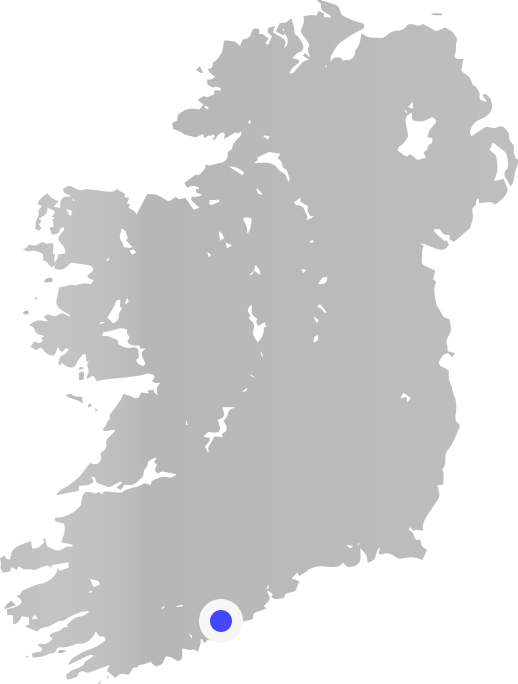
Map of Ireland

Artur Kozlowski died exploring last section of Irish Pollonora Cave

Artur Kozlowski died exploring last section of Irish Pollonora Cave

Blog

  1. Home
  2. /
  3. 2011
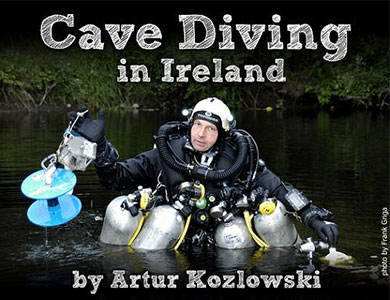
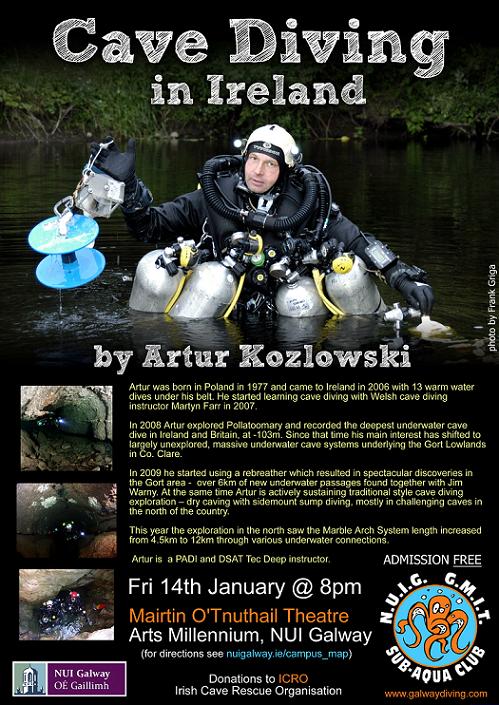
Cave diving in Ireland
Artur Kozlowski died exploring last section of Irish Pollonora Cave

Efforts will resume today to recover the body of a diver who died exploring a cave in Co Galway.

The alarm was raised when Artur Kozlowski, (34), a Polish man who was one of Ireland’s most experienced cave divers, failed to resurface from a diving trip in a flooded inland cave on Monday night.

Members of the Irish Cave Rescue Organisation located his body last night, nearly 24 hours later, about 52 metres down in the deepest section of the cave.

They plan to bring it to the surface during the day.

Mr Kozlowski had been living in Ireland for a number of years and held several records in Ireland and Britain, including one for the longest and deepest cave traverse of 103 metres.

He had enough oxygen to last more than six hours when he went into the water at Pollonora cave, Kiltartan about two and a half miles north of Gort at 3pm on Monday.

His close friend and experienced diver Jim Warney found the Polish national’s body in an underwater passage at around 6pm yesterday.

It took Mr Warney an hour to dive to the narrow passage where the victim lay with his oxygen tanks and guide rope fully attached.

The location where he was found is almost a kilometre from the access point to the cave and is 52 metres deep.

The family of the diving training instructor in Poland were informed of his death shortly after the search diver returned to the surface.

The rescue team has now requested the assistance of a UK dive rescue unit to assist in the recovery of Mr Kozlowski’s body.

Mr Kozlowski was on the final day of an underground expedition when he vanished.

The Polish national was regarded as the most prominent cave diver in the country — and it was hoped that he had sought sanctuary in an air pocket in the extensive underground cave network.

Experienced

Originally from Poznan in Poland, Mr Kozlowski lived in Shankill, Dublin, and was known to his Irish friends as Artur Conrad.

He arrived at the rural location in Co Galway on Saturday, and spent Sunday diving, before going underground for a final exploration on Monday.

Mr Warney’s search last night was his second dive in less than 24 hours, having spent Monday night searching after the alarm was raised.

After two divers searched an initial 350 metres to no avail, Mr Warney examined an un- searched area of the 800 metre-wide cave which is 52 metres deep.

Conor McGrath of the Irish Cave Rescue Organisation said a considerable air space had been discovered halfway into the underground cave and that they had hoped to uncover more. “The air space is near the surface so that gives us hope that the cave may have more similar air spaces and that he is in one of them,” Mr McGrath said before the discovery of the diver’s body.

“He is very experienced. He has very good equipment, very good training and very good knowledge. He is the only one who has been into this cave to its known limits,”

All five divers involved in yesterday’s search were friends of Mr Kozlowski. A quantity surveyor by trade, he had been living in Dublin since 2006 and began cave diving in 2007.

Friends said he quickly became involved in all aspects of cave diving and soon opened his own training company.

In 2008, he recorded the deepest underwater cave dive in Ireland and the UK at Pollatoomary, Co Mayo.

Explored

For the past two years he had extensively explored the vast underground cave network in south Galway.

Tom Nolan (86) of Croker House in Kiltartan, Co Galway, had known Mr Kozlowski since he first explored the cave at the rear of the family home in 2007.

Mr Kozlowski became a familiar face at the the bed and breakfast. “He’d come and ask: ‘What room am I in? I’ll dress the bed myself’.

“He arrived on Saturday night and was diving Sunday and Monday.

“On Monday he told my son, John, that he was going for the last stage. He wanted to see if he could connect this with the caves in the Burren. If so, it would be the biggest underground cave network in Europe.

“Artur was underground there one day and he could hear this noise,” said Mr Nolan.

“He checked all his gear to see if there was something wrong and couldn’t figure out where the noise was coming from.

“He kept listening though and eventually figured out it that the noise was from the traffic on the road above him. That is how big it is underground here.”

R.I.P buddy … 🙁

Blog:
http://www.hellandhighwater.eu/

Source: Irish Independent

Pat

Pat

Chairperson

Facebook
Instagram

Related Posts

2015 Diving Season

2015 Diving Season

Blog Phasellus consequat orci eget ex euismod vulputate at quis lorem. In euismod accumsan tortor, quis dictum ligula lacinia sit amet. Aliquam eget vulputate urna. Integer posuere lobortis elit, ac dignissim elit ullamcorper vitae. Mauris dignissim...

read more
Umbrella Rides The Wind

Umbrella Rides The Wind

Blog Phasellus consequat orci eget ex euismod vulputate at quis lorem. In euismod accumsan tortor, quis dictum ligula lacinia sit amet. Aliquam eget vulputate urna. Integer posuere lobortis elit, ac dignissim elit ullamcorper vitae. Mauris dignissim...

read more

Why go tech? Motivations behind technical diving

Blog In this essay, sports psychologist and technical diver Matt Jevon draw some parallels between the sport of technical diving and the sport of motorcycle racing, including attitudes and behaviors regarding the inherent dangers and risks, sharing...

read more

You are New

or Experienced Diver ?

You can

find us

LOCATION/CONTACT

Address Cork City
Email: info@dauntsac.com
Phone: 087 343 6711

OPENING HOURS

ALL THE TIME

Map of Ireland

Dives on Arctic wreck yield 19th century artifacts

Blog

  1. Home
  2. /
  3. 2011
Artic dives
Dives on Arctic wreck yield 19th century artifacts

OTTAWA—Archeologists diving on a 19th-century shipwreck have brought back a small supply of artifacts they hope will tell them more about the lost Franklin expedition.

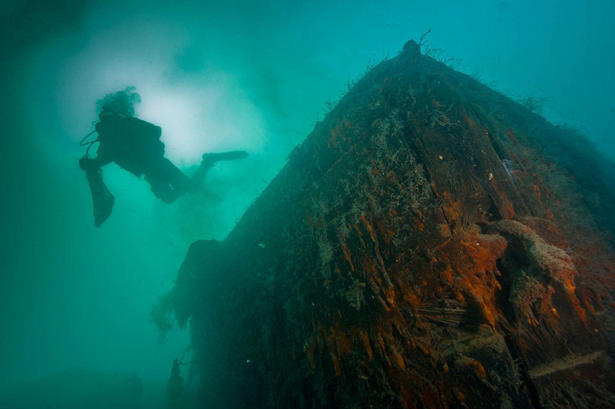
With youthful enthusiasm, veteran staff from Parks Canada showed off the ship’s fittings, copper hull plates, a British marine musket from 1842 and a pair of shoes plucked from the deck of HMS Investigator just eight meters beneath the freezing Arctic waters.

The former merchant ship made two voyages to the Arctic in search of Sir John Franklin’s storied expedition but was abandoned in 1853 after becoming stuck in the once-impenetrable Arctic ice. The ship was found last year in Mercy Bay, off Banks Island in the Beaufort Sea.

“I’ve been doing this for over 20 years,” Marc-Andre Bernier, chief of underwater archaeology services, told a news conference Thursday. “This was probably the most phenomenal and exciting project — for all of us.

“To dive on that shipwreck that is literally frozen in time … and having this phenomenal ship in front us standing proud on the bottom with artifacts on the deck was for us totally unprecedented.

“It was one of the highlights of our careers.”

A team of six divers, including one from the U.S. Parks Service, conducted more than 100 forays, aided by July’s midnight sun, under waters ranging in temperature from -2C to +2C.

What they found astounded even the most experienced among them.

Artifacts — including the shoes and a bent musket, its trigger guard altered to accommodate winter gloves — lay exposed on the ship’s decks and strewn on the sandy bottom.

Divers recovered 16 pieces, primarily to protect them from the ravages of time and ice, and to evaluate their overall condition.

The hull plates — one of which was lined with insulating felt — were particularly valuable archaeologically, said Bernier. They will help identify pieces found elsewhere and perhaps point searchers toward Franklin’s lost ships.

He said much of Investigator’s interior is filled with sediment, likely preserving many more treasures of an age long past.

HMS Investigator was purchased and refitted by the British Admiralty in 1848, the same year the ship accompanied HMS Enterprise on James Clark Ross’s expedition in a futile search for Franklin.

The vessel became trapped in the ice on the second trip and was abandoned three years later, on June 3, 1853. Investigator was inspected by crews of HMS Resolute a year later, still frozen in, and reported in fair condition despite having taken in water during the summer thaw.

While the fate of Franklin’s ships, HMS Erebus and Terror, remain a mystery, Investigator’s captain, Robert McClure, kept a log of his journey. Ship’s surgeon Alexander Armstrong published his own account in 1857.

But the wreck’s exact location was not known for more than 150 years. The area is among the most inaccessible and inhospitable on Earth.

This year, the ice in Mercy Bay opened up enough to allow divers nine straight days of unimpeded underwater exploration.

The crew was also able to look at a nearby, previously unexplored paleo-Inuit site believed to have been inhabited over the course of about 2,000 years.

Meanwhile, the search for Franklin’s expedition continues.

Explorers are shrinking the search area each year by about 150 square kilometers. They believe the wrecks have probably drifted far from their last known locations.

“These are national historic sites,” Bernier said of the Franklin ships. “They are the only national historic sites for which we don’t know the location.

“So we take this as a responsibility and we are trying to locate, basically, our only unknown historic sites.”

Environment Minister Peter Kent, whose portfolio includes National Parks, considers the search part of Canada’s sovereign Arctic responsibility.

“We reinforced Canada’s presence in the Arctic waters,” he said.

“But perhaps best of all, we uncovered further information that will help strengthen the compelling connection to the Arctic that is the birthright of each and every Canadian.”

Source: www.thestar.com

Pat

Pat

Chairperson

Facebook
Instagram

Related Posts

2015 Diving Season

2015 Diving Season

Blog Phasellus consequat orci eget ex euismod vulputate at quis lorem. In euismod accumsan tortor, quis dictum ligula lacinia sit amet. Aliquam eget vulputate urna. Integer posuere lobortis elit, ac dignissim elit ullamcorper vitae. Mauris dignissim...

read more
Umbrella Rides The Wind

Umbrella Rides The Wind

Blog Phasellus consequat orci eget ex euismod vulputate at quis lorem. In euismod accumsan tortor, quis dictum ligula lacinia sit amet. Aliquam eget vulputate urna. Integer posuere lobortis elit, ac dignissim elit ullamcorper vitae. Mauris dignissim...

read more

Why go tech? Motivations behind technical diving

Blog In this essay, sports psychologist and technical diver Matt Jevon draw some parallels between the sport of technical diving and the sport of motorcycle racing, including attitudes and behaviors regarding the inherent dangers and risks, sharing...

read more

You are New

or Experienced Diver ?

You can

find us

LOCATION/CONTACT

Address Cork City
Email: info@dauntsac.com
Phone: 087 343 6711

OPENING HOURS

ALL THE TIME

Map of Ireland

Roman shipwreck full of wine jars found in Albania

Roman shipwreck full of wine jars found in Albania

Blog

  1. Home
  2. /
  3. 2011
Roman jars
Roman shipwreck full of wine jars found in Albania

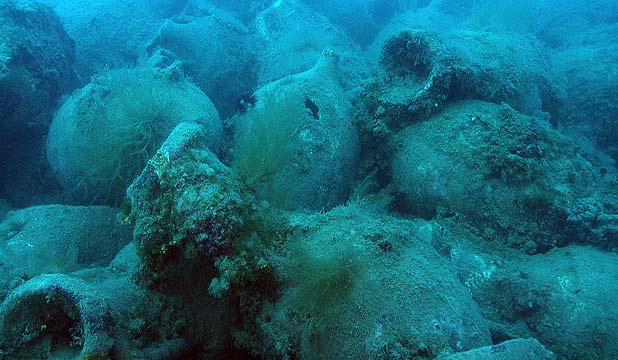
A US-Albanian archaeological mission claims to have found the well-preserved wreck of a Roman cargo ship off Albania’s coast, complete with some 300 wine jars — all empty, alas.

The 30-meter-long wreck dates to the 1st century BC and its cargo is believed to have been the produce of southern Albanian vineyards en route to western European markets, including France.

A statement from the Key West, Florida-based RPM Nautical Foundation said the find was made 50m deep near the port city of Vlora, 140 kilometers southwest of the capital, Tirana, early this month.

The foundation, in cooperation with Albanian archaeologists, has been surveying a swathe of Albania’s previously unexplored coastal waters for the past five years. So far, experts have located 20 shipwrecks — including several relatively modern ones.

“Taking into consideration the date and also the depth — which is well suited for excavation — I would include it among the top 10 most scientifically interesting wrecks found in the Mediterranean,” said Albanian archaeologist Adrian Anastasi, who participated in the project.

Officials said most of the jars, known by their Greek name of amphoras and used to transport wine and oil, were unbroken despite the shipwreck. However, the stoppers used to seal them had gone, allowing their contents to leak out into the saltwater.

Mission leader George Robb said the ship could have been part of a flourishing trade in local wine.

“Ancient Illyria, which includes present-day Albania, was a major source of supply for the western Mediterranean, including present-day France and Spain,’ Robb said.

Team members retrieved one amphora for examination, before restoring it to the wreck. The site, whose precise location is being kept secret, will be left unexplored until the Albanian archaeological service is in a position to do so.

The monthlong mission ended last week and will be resumed next year. According to Albanian coordinator Auron Tare, it will eventually cover the whole Albanian coastline.

“These five years have shown how rich the Albanian underwater coastline is, and how interesting it could be for international tourists,” he said.

Source: www.waikatotimes.co.nz

Pat

Pat

Chairperson

Facebook
Instagram

Related Posts

2015 Diving Season

2015 Diving Season

Blog Phasellus consequat orci eget ex euismod vulputate at quis lorem. In euismod accumsan tortor, quis dictum ligula lacinia sit amet. Aliquam eget vulputate urna. Integer posuere lobortis elit, ac dignissim elit ullamcorper vitae. Mauris dignissim...

read more
Umbrella Rides The Wind

Umbrella Rides The Wind

Blog Phasellus consequat orci eget ex euismod vulputate at quis lorem. In euismod accumsan tortor, quis dictum ligula lacinia sit amet. Aliquam eget vulputate urna. Integer posuere lobortis elit, ac dignissim elit ullamcorper vitae. Mauris dignissim...

read more

Why go tech? Motivations behind technical diving

Blog In this essay, sports psychologist and technical diver Matt Jevon draw some parallels between the sport of technical diving and the sport of motorcycle racing, including attitudes and behaviors regarding the inherent dangers and risks, sharing...

read more

You are New

or Experienced Diver ?

You can

find us

LOCATION/CONTACT

Address Cork City
Email: info@dauntsac.com
Phone: 087 343 6711

OPENING HOURS

ALL THE TIME

Map of Ireland
Donegal wreck may have Spanish Armada link

Donegal wreck may have Spanish Armada link

Blog

  1. Home
  2. /
  3. 2011
Spanish armada
Donegal wreck may have Spanish Armada link

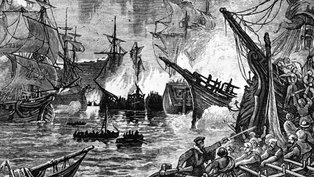
TWO SHIPWRECKS discovered off the Donegal coastline may be linked to the late 16th-century Spanish Armada and a separate late 18th-century French armada, despatched to assist Irish rebellion efforts.

However, identification of the two wrecks outside Burtonport harbour may take some time, Connie Kelleher of the Department of Arts, Heritage and the Gaeltacht’s underwater archaeology unit, said yesterday.

The two shipwrecks, one of which is definitely a warship, are lying 200m apart in just four metres of water off Rutland Island close to Burtonport.

Lead shot balls were retrieved during dives in which Ms Kelleher participated yesterday morning. Pottery has also been recovered from within the hull of the possible Spanish Armada ship, which is filled with sediment.

A full excavation of material is under way, as part of a long-term management plan for the location.

Minister for Arts, Heritage and the Gaeltacht Jimmy Deenihan has awarded €50,000 for the work, and the Geological Survey of Ireland’s vessel Keary, named after late geologist Raymond Keary, is providing a support platform for the dive team.

Many of the wrecks already located lie off the north and west coasts, off Inishowen in Co Donegal; Co Sligo; Clare Island, Co Mayo; Co Galway; and Co Clare; and the Blasket Sound in Kerry.

Five of the hulls, or remains of same, have been located off Donegal, and the three wrecks off Streedagh strand in Sligo were the subject of a protracted court action.

The two wrecks now under investigation were originally pinpointed by Donegal divers, including Liam Miller, Oscar Duffy and Michael Early in 2008-2009. At this stage, identification is uncertain, but Ms Kelleher believes they may be “enormously significant”.

The later wreck, possibly French, could be linked to Napper Tandy’s revolutionary efforts. Tandy (1740-1803), who worked with Wolfe Tone in founding the United Irishmen, accepted a French government offer of a corvette, the Anacreon, and sailed from Dunkirk with United Irishmen and arms, arriving on Arranmore island, close to Burtonport, in September 1798.

However, locals were said to be less than supportive of his aims.

Tandy also learned that Gen Humbert’s expedition had been defeated in Mayo. Nevertheless, he took possession of Rutland, hoisted an Irish flag, and issued a proclamation before leaving and sailing north.

The Geological Survey of Ireland, which is mapping Irish inshore areas as part of the national seabed survey Infomar, will use sidescan sonar and magnetometer equipment in the area to check if there are any other ships.

Mr Deenihan said yesterday that he was “delighted” to be able to support investigations into “a major find of significance not only to Ireland, but also to the international archaeological, historical and maritime communities”.

Mr Deenihan said that if one of the wrecks proves to be from the Spanish Armada, it could constitute one of the most intact on this coast to date and could provide “huge insight into life on board and the reality of the military and naval resources available to the armada campaign”.

He paid tribute to the co-operation of the National Monuments Service and the National Museum of Ireland, which will take responsibility for any artefacts recovered.

SPANISH ARMADA

SOME 24 to 26 Spanish Armada ships are believed to have foundered off the Irish coast in 1588 while en route to invade England under the command of King Philip II.

At least 14 of the sunken ships have been extensively mapped to date.

The total armada fleet of 130 ships, with 29,453 sailors and soldiers on board, comprised 65 warships, 25 transport vessels, four galleys and a number of smaller vessels.

When the fleet was defeated in the English Channel, a scattered fleet opted for the Scottish and Irish west coast route home, but ran into storms. “God breathed and England was saved” was Sir Francis Drake’s later remark about the maritime disaster, which resulted in less than 75 per cent of the fleet making it home.

Source: www.irishtimes.com

Pat

Pat

Chairperson

Facebook
Instagram

Related Posts

2015 Diving Season

2015 Diving Season

Blog Phasellus consequat orci eget ex euismod vulputate at quis lorem. In euismod accumsan tortor, quis dictum ligula lacinia sit amet. Aliquam eget vulputate urna. Integer posuere lobortis elit, ac dignissim elit ullamcorper vitae. Mauris dignissim...

read more
Umbrella Rides The Wind

Umbrella Rides The Wind

Blog Phasellus consequat orci eget ex euismod vulputate at quis lorem. In euismod accumsan tortor, quis dictum ligula lacinia sit amet. Aliquam eget vulputate urna. Integer posuere lobortis elit, ac dignissim elit ullamcorper vitae. Mauris dignissim...

read more

Why go tech? Motivations behind technical diving

Blog In this essay, sports psychologist and technical diver Matt Jevon draw some parallels between the sport of technical diving and the sport of motorcycle racing, including attitudes and behaviors regarding the inherent dangers and risks, sharing...

read more

You are New

or Experienced Diver ?

You can

find us

LOCATION/CONTACT

Address Cork City
Email: info@dauntsac.com
Phone: 087 343 6711

OPENING HOURS

ALL THE TIME

Map of Ireland